
Does My Mazda Have A CV Joint Or CV Axle? What's The Difference?
If you're not familiar with modern suspensions, terms like "Constant Velocity" may sound intimidating. But, with only a little explanation, the CV assembly is fairly easy component to understand. If you're questioning the difference in a CV joint and CV axle, this post will explain just that.
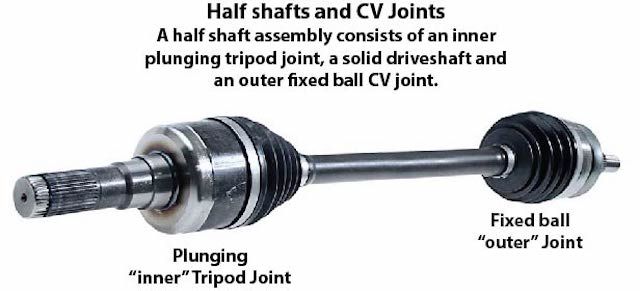
All modern Mazdas have Constant Velocity (CV) joints. A CV axle, also called a half-shaft, is an axle assembly consisting of an inner and an outer CV joint. So, a CV joint is simply one part of the entire CV axle assembly. CV axles are used on all front-wheel drive (FWD) vehicles. They transfer power from the transaxle to the front wheels. CV joints are required on FWD cars to accommodate the motion of the front suspension and the steering of the front wheels.
CV axles can also be used on rear-wheel drive (RWD) vehicles, like the Mazda MX-5 Miata and RX-8, which have independent rear suspension. Independent suspension means each wheel moves freely from the other, unlike a car with a solid or beam axle. CV axles connect the rear differential to the rear wheels. This allows the rear suspension to move freely and independently on each side.
Do you want to learn more about axle assemblies? Check out our guide.
Types Of CV Joints
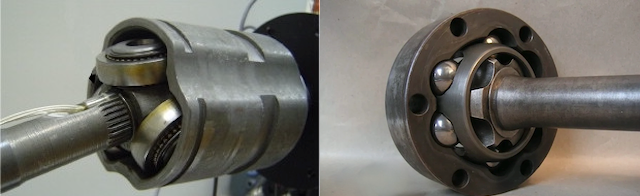
There are two common types of CV joints used on CV axles, ball-type and tripod-type joints. FWD cars use ball-type CV joints on the outboard side of the axle shaft (closest to the wheel). Tripod-type CV joints are used on the inboard side of the axle shaft (closest to the transmission or differential). Ball-type CV joints allow more articulation for both suspension movement and steering the front wheels. Tripod-type CV joints allow for vertical movement of the suspension only.
Differences In Inboard And Outboard CV Joints
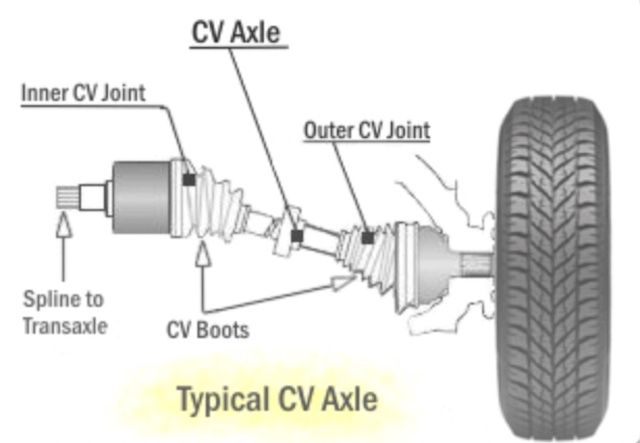
CV joints can either be a fixed (outboard) or plunge (inboard) type, depending on their location.
- Outboard CV joints are commonly the fixed type. The fixed-type CV joint design allows necessary suspension travel and steering movement, but does not allow any in-and-out movement.
- Inboard CV joints use a plunge-type design. The inboard end of the CV axle slides or "plunges" within the inner CV joint. This freedom of moment allows the CV axle to change length and compensate for varying angles of suspension travel.
CV Joint Wear
Inboard CV joints tend to be better protected by their location in the undercarriage. Belly pans or other protective shields often cover them. Inboard CV joints tend to last longer due to less exposure to hazards and a limited range of motion.
Outer CV joints tend to wear faster because of the greater range of motion and more environmental or road hazard exposure. Located inside the wheel, they are more vulnerable to road debris, dirt, and moisture. Because of this, outboard CV joints are at greater risk for CV boot damage.
The CV boot keeps the joint sealed and lubricated. A damaged boot can cause rapid failure of the CV joint. If caught early, it's possible to replace only the boot and regrease the joint. Once a CV Joint is worn, it's best to replace the whole CV axle as an assembly. Learn more in these posts about diagnosing and repairing CV joints and CV axles.
The Best Quality CV Joints At The Best Prices
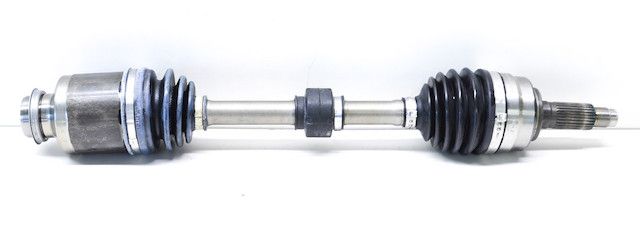
If you discover you need to replace your CV boots, joints or the entire CV axle assembly, you can find the largest selection of OEM parts for your Mazda at REALMazdaParts.com. When you buy from us you can be sure that:
- We have the right OEM CV axles or CV joints for your specific Mazda vehicle.
- All our OEM parts are backed by Mazda's manufacturer warranty.
- We;re here to offer support. If you have any questions, we're always here to help. Please contact us!